
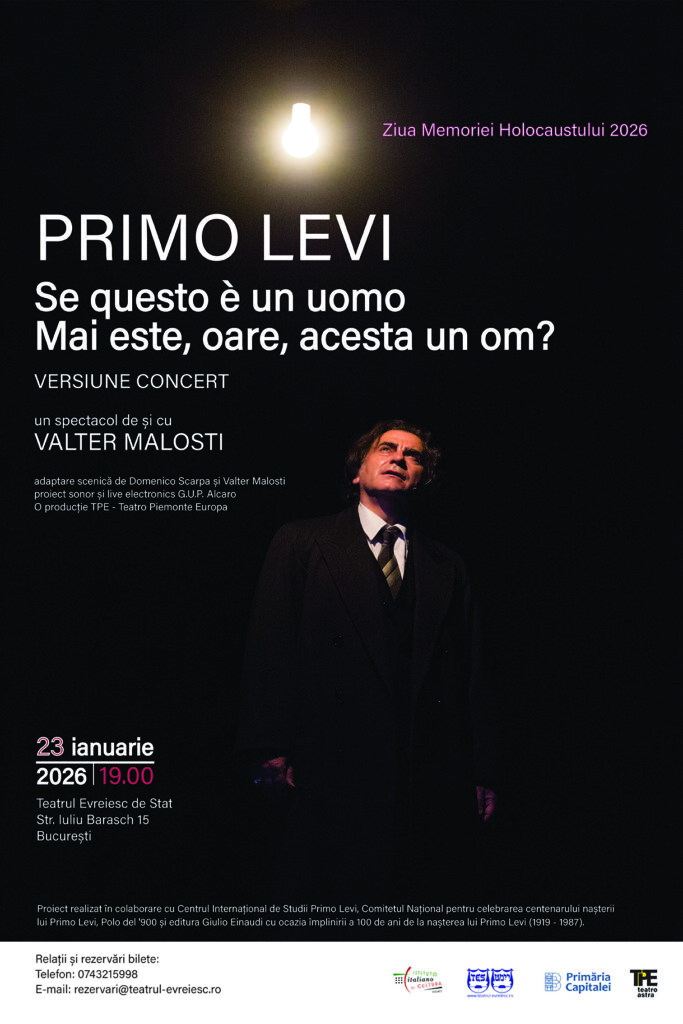
A project carried out with the International Primo Levi Studies Centre, the National Committee for the centenary of Primo Levi's birth, Polo del '900 and the publisher Giulio Einaudi, on the hundredth anniversary of the birth of Primo Levi (1919-1987).
Primo Levi's voice is the voice that knew how to speak about Auschwitz better than any other: the voice that for more than seventy years, through If This Is a Man, has told readers all over the world the truth about the Nazi extermination. It is a voice of unmistakable timbre, gentle and measured: "consider that this happened".
Valter Malosti brings that singular first book to the stage - the most atrocious and most beautiful book of adventures of the twentieth century - with nothing standing between it and us. A voice that, in its bareness, can render the chaos of the camp: the sounds, the threats, the horrors, the noise of the death factory. Levi's voice, then, apparently whispered, yet with an enormous acoustic power.
Dante's Commedia, as everyone knows, is a powerfully oral poem. For anyone approaching that great poem with few tools for reading it on the paper of its thousand editions, it can be difficult. But as soon as those words pass through an actor's body, one suddenly understands much or almost everything; many things travel beyond meaning. The same is true of If This Is a Man. Spoken aloud, Levi's words reveal all the force of a great poem, inexhaustible and terrible. And what can the whole book be if not a transfiguration of Dante's first canticle.
The stage adaptation was made by Domenico Scarpa and by Malosti himself. The voice is that of a witness-protagonist, but in several registers. The voice of If This Is a Man in fact holds a multitude of registers - expressive, narrative, perceptive, reflective. These registers, frames of thought in the making, are the real action of the text. Reflections, flickers, philosophical and psychological readings, flashbacks and flashforwards. "I wanted to make a work," says Malosti, "that would be hard and strong, as if those words had been cut into stone. Often, reading and rereading the text, I thought of ancient theatre. That is where the idea of the choruses came from, out of Levi's poetry, which he also called cantos."
The director adds: "I am convinced that listening to a work like If This Is a Man together with others is very different from reading it alone; I came to see how important it is to share these words in public. I who have never made political theatre felt, in this case, the civic usefulness of listening collectively, as a group."
In this unusual "concert version" of the production, Gup Alcaro's live sound design matters a great deal: for Malosti, Se questo è un uomo is in fact an acoustic work. Set against it, in pure and perfect form, are the three original madrigals composed by Carlo Boccadoro from the poems Levi wrote in 1945-46, immediately after his return from the extermination camp at Auschwitz.
Presented at the State Jewish Theatre, in partnership with the Italian Cultural Institute
Friday 23 January, 19.00
Tickets can be bought here.